

Last Updated on July 14, 2026 by Christian Adams
This is the story of Louis Thomas Hardin, better known as Moondog: part mystic, part prankster, part genius, and one of the most unusual figures in 20th-century music.
If you’ve seen The Big Lebowski (1998), you’ve already heard Moondog, even if you didn’t realize it. The Coen Brothers famously used his compositions, including “Theme” and “Stamping Ground” (from his 1969 self-titled album), in two memorable scenes. The music provides the perfect, off-kilter soundtrack to the Dude’s existence, quietly slipping this mysterious Viking-cloaked composer into the subconscious of millions of Dude-abiding viewers. But Moondog’s life was far stranger and more colorful than a soundtrack cameo in a cult classic.
The Viking of Sixth Avenue
From the late 1940s until 1972, Moondog was an unforgettable fixture on the streets of New York, often found on 6th Avenue between 52nd and 55th Streets, cloaked and topped with a Viking-style helmet—sometimes busking, usually just standing silent and still. He was widely recognized as “The Viking of 6th Avenue” by thousands of passersby who had no idea that this blind eccentric was a musical polymath whose work blended street noise, jazz, classical counterpoint, invented instruments, and rhythms he claimed came from a cosmic source beyond 4/4 time.

Early Life: Before the Helmet
Moondog was born in Kansas in 1916, raised partly in Wyoming, and introduced to rhythm early by playing a homemade cardboard-box drum at age five. A tragic farm accident at 16 left him blind, redirecting his life and focus entirely toward sound.
He studied at schools for the blind across the Midwest, learning theory through braille but developing his true voice by ear. Drums were his first love, but composition soon dominated everything he did. His early exposure to Native American music made a lasting imprint on his sense of rhythm and form. That influence never left him.
Hardin eventually moved to Batesville, Arkansas, where he resided until 1942. His dedication led to a scholarship to study in Memphis, Tennessee, though his primary learning remained through deep listening and tactile engagement with braille musical texts.
Becoming Moondog in New York
In 1943, Hardin made the pivotal move to New York City, where he sought out the heart of the American musical scene. He quickly connected with numerous musical luminaries from both the classical and jazz worlds. He met conductors like Leonard Bernstein and Arturo Toscanini, who would become early champions of his work, and legendary jazz figures such as Charlie Parker and Benny Goodman. The vibrant, often humorous, and upbeat tempos of modern jazz heavily influenced Hardin’s own compositional outlook.
New York in the 1940s was a combustible mix of jazz clubs, classical institutions, and street chaos. In 1947, Hardin adopted his new name, “Moondog,” in honor of a dog from his childhood who howled at the moon with impressive dedication.

The Lawsuit That Defined a Name
In 1954, Moondog’s chosen identity was challenged, leading to a landmark legal case. He successfully sued the powerful disc jockey Alan Freed, who had branded his popular radio show, “The Moondog Rock and Roll Matinee,” around the name, even using Moondog’s composition “Moondog’s Symphony” as the program’s signature theme. Moondog contested the use of the nickname, asserting his long-established identity.
The case went to the New York State Supreme Court. Crucially, Moondog’s claim to be a serious composer was supported by testimony from established classical and jazz figures, including Benny Goodman and Arturo Toscanini. Based on this evidence, the court ruled in Hardin’s favor. Freed was forced to issue an apology and cease using the name “Moondog” on air, confirming that Louis Hardin was the rightful owner of the moniker in the public sphere long before Freed began capitalizing on it.
The Viking of Sixth Avenue
From the late 1940s until his departure in 1972, Moondog became a beloved, instantly recognizable cultural landmark in midtown Manhattan. He lived as a street musician and poet, often settling on the corner of 53rd or 54th Street and 6th Avenue. His distinctive appearance was not merely theatrical; it was a carefully curated persona. Already sporting a long beard and hair, he eventually added the iconic Viking-style horned helmet and cloak to his ensemble.
He explained that this attire was adopted to discourage the frequent comparisons of his appearance to that of Christ or a monk, as he had rejected Christianity in his late teens and developed a deep, lifelong interest in Nordic mythology, maintaining an altar to the Norse god Thor even at his country retreat.
Despite his prominent street presence, Moondog was not always homeless. He maintained an apartment in upper Manhattan and owned a rural retreat in Candor, New York, to which he eventually relocated in 1972. He sustained himself financially by selling his poetry, small musical notations, and writings on his unique musical philosophy to passersby.
The Music: Snaketime, Counterpoint, and the Sounds of the Street
Moondog’s compositions drew inspiration from a vast and eclectic range of sources. These included the music of Native Americans (an interest kindled in childhood and reinforced by a trip to a Blackfoot Sun Dance in Idaho in 1949, where he performed on flute and percussion), contemporary classical music, modern jazz, and, uniquely, the everyday sounds of his environment.
His work is characterized by what he termed “snaketime,” a concept of rhythmic complexity and fluidity. He described this as “a slithery rhythm, in times that are not ordinary… I’m not gonna die in 4/4 time.” This interest in non-standard time signatures (such as 5/4 and 7/4) and polyrhythms gave his work a singular, shifting quality.
Many of his compositions are highly contrapuntal, marked by the simultaneous combination of two or more melodic lines that are harmonically interdependent but rhythmically independent. He was known to have rigorously pursued the perfection of his counterpoint, famously engaging with the work of J.S. Bach, whom he sometimes criticized for what he saw as minor “mistakes” in his own pursuit of theoretical purity.
He also invented instruments, including:

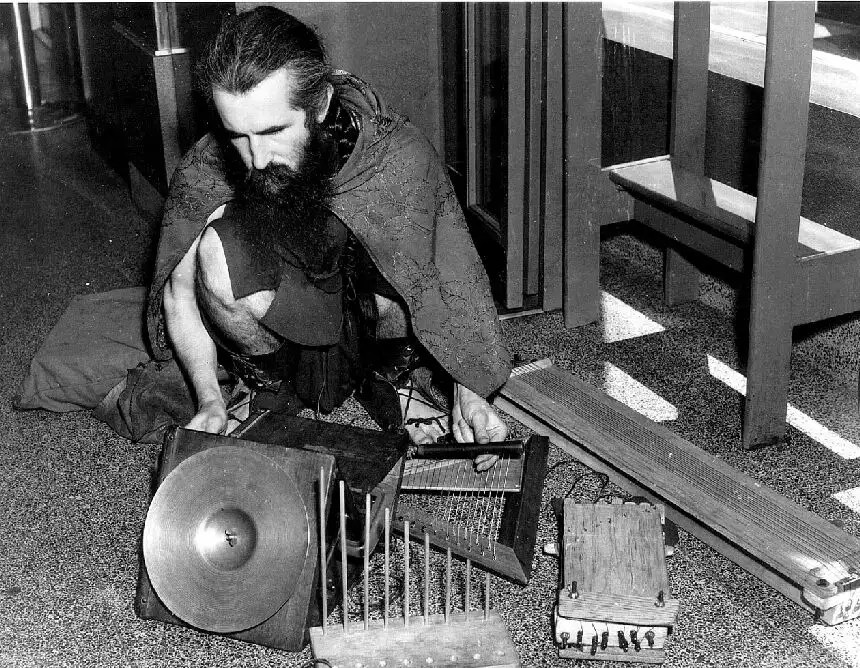
Trimba — a triangular percussion instrument that became his sonic signature
Oo and the Ooo-ya-tsu — small harplike creations
Hüs — a bowed triangular instrument
These weren’t gimmicks. They were extensions of his musical universe: angular, percussive, and utterly unlike anything on the scene.
The Columbia Records Era and Mid-Career Work (< 1980)
After releasing several recordings on independent and jazz labels in the 1950s (including an unusual record of stories and songs for children in 1957, Songs of Sense and Nonsense – Tell it Again, with Julie Andrews and Martyn Green), Moondog entered a recording hiatus that lasted over a decade.
Moondog (1969)
His career experienced a resurgence in 1969 when producer James William Guercio (Blood, Sweat & Tears, Chicago) invited him to record an album for Columbia Records.
This highly acclaimed, self-titled album compiled various pieces of music Hardin had been perfecting since the 1950s. The record showcased the breadth of his compositional skills, featuring:
- Minisyms: Moondog’s term for short, symphonic-styled works performed by small orchestras.
- Canons and Chaconnes: Including a chaconne dedicated to the memory of jazz legend Charlie Parker.
- Ballet Music: Works originally written for choreographer Martha Graham, such as “Witch of Endor.”
- Symphonic Works: Including pieces dedicated to Benny Goodman, featuring elements of classic swing.
The album was hailed by critics as a masterpiece of fusion, bridging the gap between classical formality and modern, inventive rhythm. The inclusion of tracks like “Theme” cemented his legacy as a crossover innovator.
Moondog 2 (1971)
The second album produced with Guercio, subtitled Madrigals: Rounds and Canons, consisted of 26 canons. These were performed by a small group led by Hardin that included his daughter, June Hardin, and a small band of musicians utilizing period instruments. While perhaps less commercially impactful than the first Columbia release, Moondog 2 remains a fascinating display of Moondog’s genius-level understanding of counterpoint and his ability to work with limited resources to create charming, complex musical structures.
Selected Early Discography
Moondog’s early recorded output laid the foundation for his reputation as a unique figure operating between the jazz and classical worlds.
- 1953: Moondog and His Friends (Epic)
- 1956: Moondog (Prestige)
- 1956: More Moondog (Prestige)
- 1957: The Story of Moondog (Prestige)
- 1969: Moondog (Columbia)
- 1971: Moondog 2 (Columbia)
- 1977: Moondog in Europe (Kopf)
- 1978: H’art Songs (Kopf)
- 1979: A New Sound of an Old Instrument (Kopf)
Germany: The Second Life of Moondog
In the mid-70s, a young German music enthusiast named Ilona Sommer invited Moondog to Germany, eventually helping create the publishing infrastructure that preserved his work. The move changed everything. In Germany, he found the institutional support he’d never quite received in the US. Studios, musicians, archivists, and the public embraced his eccentricity.
He lived with Sommer’s family, composing hundreds of pieces that she painstakingly transcribed from braille. His late works, especially Elpmas and Sax Pax for a Sax, reflect a cleaner, more spacious sound while maintaining that unmistakable Moondog logic.
Moondog remained in Germany for the rest of his life, periodically returning to the States for concerts until his passing in 1999.
Influence and Legacy
Moondog’s influence on contemporary music far exceeds his popular recognition. His work from the 1940s and 50s is widely cited as a strong influence on the early minimalist movement. Philip Glass famously acknowledged that he and fellow composer Steve Reich took Moondog’s work “very seriously and understood and appreciated it much more than what we were exposed to at Juilliard.” His rhythmic complexity and structural purity offered a blueprint for the nascent genre.

Beyond minimalism, Moondog’s unique sound has resonated through generations of musicians:
Jazz and Rock
British jazz composer Kenny Graham recorded the 1957 album Moondog and Suncat Suites, which dedicated one entire side to Graham’s arrangements of Moondog’s compositions.
Big Brother and the Holding Company, featuring Janis Joplin, recorded a psychedelic rock version of his song “All Is Loneliness” on their self-titled first album in 1967.
Jazz organist Jimmy McGriff included “Spear for Moondog” (parts I and II) on his 1968 album Electric Funk.
Glam rockers Marc Bolan and T. Rex paid tribute to him in the song “Rabbit Fighter” with the line, “Moondog’s just a prophet to the end…..”
Pop and Electronic
The English ethereal wave group Prefab Sprout included the song “Moondog” on their 1990 sophisti-pop album Jordan: The Comeback.
The song “Bird’s Lament (In Memory of Charlie Parker)” was famously sampled by Mr. Scruff for his single “Get a Move On,” bringing Moondog’s melodies to a new generation of electronic music fans.
Other artists who have performed or referenced his work include The Insect Trust, Antony and the Johnsons, and Pink Martini, confirming that the groundbreaking sounds created by the blind Viking of Sixth Avenue continue to inspire composers and musicians across all genres, long after his vigil on the streets of New York came to an end.
His piece “Bird’s Lament” remains one of the most recognizable downtempo samples in modern music.
Final Thoughts
And then, of course, there’s The Big Lebowski, the film that unexpectedly became his passport to immortality. Jeff Bridges remembers seeing Moondog as a kid on the street, handing out leaflets. Years later, Bridges was delighted to discover that the odd man in the helmet was not only a real composer, but one Bernstein himself had written liner notes for. T-Bone Burnett, the film’s music supervisor, slipped Moondog’s music into the soundtrack, giving the Viking of Sixth Avenue a posthumous spotlight he would’ve appreciated.
We welcome your comments!