
Last Updated on July 25, 2026 by Christian Adams
Discovery of the Week is a weekly series that digs through a box of 40 well-traveled CDs I’ve carried across the ocean for nearly two decades. Each disc has its own history—where I found it, why I kept it, and what it means to me. Some are classics, others are obscure relics, but all survived the endless purges and border crossings that come with long-term expat life.
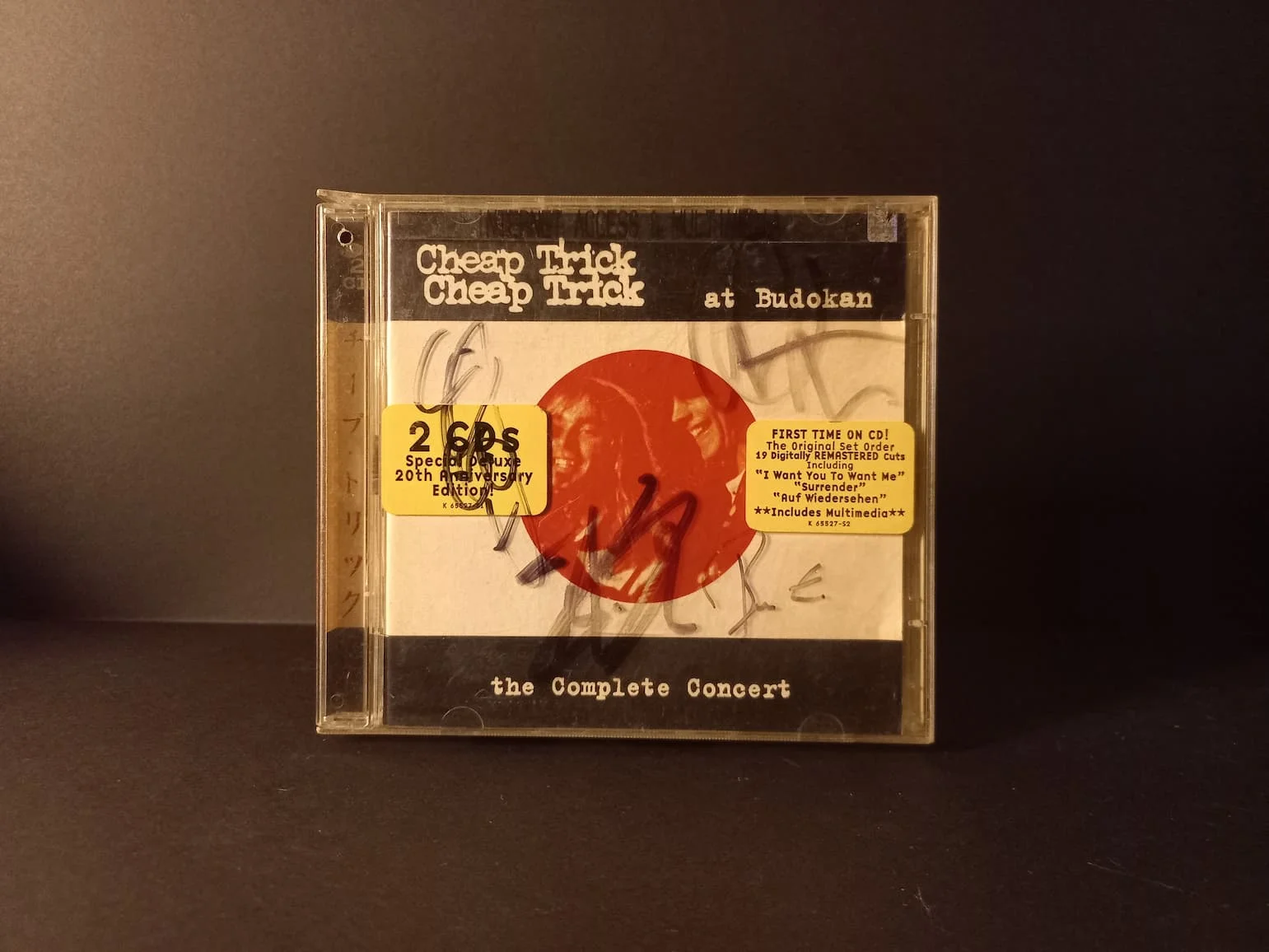
Through these records, I’m tracing the soundtrack of a life spent in motion, and in a way, trying to explain how music, memory, and geography blur together when “home” is always somewhere else. Cheap Trick at Budokan: The Complete Concert is one of the few records that survived thousands of miles and countless reinventions.
I bought this at Amoeba Records on Haight Street in San Francisco sometime between 2005 and 2007. I don’t remember exactly how it wound up in Taipei, and by extension, here today. However, I’ve owned at least one copy of Cheap Trick at Budokan since its release in 1978. It’s one of my three favorite records, and quite literally changed my life.

Cheap Trick at Budokan: The Complete Concert
All four members signed the double CD package, and I vaguely remember paying a premium for it.
For the uninitiated, Cheap Trick is a rock band from Rockford, Illinois, and Cheap Trick at Budokan is arguably the band’s finest album, containing frenetic live versions of their two biggest and most enduring hits, “I Want You (To Want Me)” and “Surrender”. Drawing heavily on power pop and hard rock influences such as the Beatles, the Who, and the Move, Cheap Trick is also considered one of the elite American rock bands of all time.

By 1978, the band had released three studio albums on Epic Records that sold moderately in the U.S.; however, they went gold in Japan.
Recording and Legacy
Recorded at the famed Budokan Theater, Tokyo, in April 1978 and released in October 1978, Cheap Trick at Budokan was intended to be a promotional “Thank you” to the Japanese—mostly teenage female—fan base. A radio DJ in Boston obtained an import copy and started playing “I Want You (To Want Me)”, and it spread like wildfire. Eventually, the record label released the album stateside in February 1979.
Cheap Trick at Budokan has since sold 3 million copies in the U.S. and 5 million worldwide.

At Budokan: The Complete Concert (1998) is a 20th anniversary reissue, remastered and fully restored, which includes all the concert tracks left off the original album.
| At Budokan: The Complete Concert track list *indicates not on the original album |
| Disc 1 |
| “Hello There” |
| “Come On, Come On” |
| “ELO Kiddies”* |
| “Speak Now or Forever Hold Your Peace”* |
| “Big Eyes” |
| “Lookout” |
| “Downed”* |
| “Can’t Hold On”* |
| “Oh Caroline”* |
| “Surrender” |
| “Auf Wiedersehen”* |
| Disc 2 |
| “Need Your Love” |
| “High Roller”* |
| “Southern Girls”* |
| “I Want You to Want Me” |
| “California Man”* |
| “Goodnight” |
| “Ain’t That a Shame” |
| “Clock Strikes Ten” |
The following story is a deleted scene from a very early version of my book, Year of the Rat. Originally titled “12,000 Screaming Japanese Girls Can’t Be Wrong”, this heavily edited version appeared in a compilation of stories called That’s a Lot of Climbing to See a Fucking Statue.
How Cheap Trick Changed My Life
Christmas 1978 was a pivotal moment in my life for one oddly satisfying reason: my parents forbade me from buying, possessing, or discussing anything related to Kiss from that point forward. They never gave me one specific reason, but it had something to do with drugs. I don’t know.
For the previous two years, I, along with every other kid in my town, was infatuated with the American hard rock band Kiss. However, unlike many of my friends, I owned every Kiss record—album and single—released in the U.S., several pricy European imports, and the four “solo” albums, which had recently arrived at the local K-Mart. In certain cases, I owned doubles of LPs like Alive II (1977) and Hotter than Hell (1974)—one for playing, one for displaying.
Kiss Fever, Part 1
Kiss fever was epidemic; their merchandise flooded the marketplace (including board games, makeup and masks, and pinball machines), and the group had two Marvel comic books as well as a made-for-TV movie, Kiss Meet the Phantom of the Park—which is, without question, one of the worst films ever made.
The Kiss posters plastered the walls of my bedroom. Of course, I also had Kiss t-shirts, action figures, a baseball hat, and a lunch box.

Kiss fever began sweeping the American mainstream in 1975 with the release of Alive!, a double-live album containing the single “Rock ‘N’ Roll All Nite,” which rose to number 12 on the American charts. Meanwhile, I was learning to play drums in my school’s jazz band, as well as gaining exposure to a variety of musical genres from classical to heavy metal to bubblegum.
My sister didn’t buy nearly as many records as I did, but she usually bought the popular stuff at the moment—strictly Top 10 records—and she got bored with a record after just a few spins. And that’s also how I wound up with far more Cat Stevens albums than anybody should be allowed to possess.
Anyway, Kiss’ fourth album, Destroyer (1976), contained a cheesy little ballad called “Beth,” which turned out to be their highest-charting single. Once the novelty of the song wore off, in exchange for washing her dishes, my sister unloaded the album on me. And that’s how I became infatuated with Kiss.
Kiss Fever, Part 2
Not long after I got my paws on Destroyer, I bought every Kiss record available. After a while, I ran out of Kiss records to buy. Despite the band’s prolific discography, Kiss records didn’t come out fast enough for me.
In early 1978, Kiss was still the most popular band in America.
My drum set and stereo system resided in the basement, where I had a little corner wallpapered with rock posters. By Christmas ‘78, I was also into the Beatles, the Who, Led Zeppelin, Pink Floyd, Black Sabbath—all the classic rock bands. And probably more importantly, the first Van Halen album had seriously rocked my world, being the first record to make me think, I wanna be a rock star.
My parents never said much about my musical taste, as long as I continued to get good grades. Good grades were everything. Many parents of 1970s children didn’t have time to worry about what we were up to in our free time, just as long as we were busy. They figured Kiss was just a phase, and I would be over it soon enough. And they were right, sort of. When I saw some second-graders at school wearing Kiss t-shirts, I knew the end was near. Kiss is for kids, I thought.
Kiss Them Goodbye
That afternoon in late December, I was practicing my drums to “Calling Dr. Love”, wearing headphones and playing along to the jam. The song ended, and before I could turn around to move the needle to the beginning of the track, I heard insistent knocking at the basement door—obviously, my parents, unhappy about the noise. And I’d inadvertently locked the door; otherwise, they would have simply flashed the lights on and off.
Long story short, my parents demanded that I get rid of everything related to Kiss: the records, the merchandise, everything.

Ironically, I didn’t even care about Kiss in the moment. Their music was fucking negligible. No longer infatuated with the appeal of their image, I was trying to buy time.
My father snapped, “I said, get rid of it!” and he clearly wasn’t fucking around.
“He’s got t-shirts and a baseball cap, too,” my mother chimed in.
“All of it,” my father continued. “From this moment forward, anything Kiss-related is banned. I don’t want to see or hear another minute of it.”
“What am I supposed to do with it? Throw it away?”
“That’s not my problem. Sell it, burn it, I don’t care.”
Prepubescent Commodities
In those days, we traded vinyl records like we traded baseball cards or Hot Wheels die-cast toy cars. These were our pre-pubescent commodities. At 10, I was mowing lawns, delivering newspapers, and getting good grades to afford my “luxuries”, i.e., rock records. Thinking long-term investment over instant gratification, I took my record collection very seriously.
Immediately following the basement incident, my mother went through my closet and confiscated my Kiss T-shirts. The lunch box and action figures were donated to the Salvation Army thrift store. Fortunately, my father was reasonable enough and gave me a chance to trade the records and posters for something of equal or perhaps lesser value, as long as it wasn’t Kiss-related. Like 48 hours to get rid of everything.
After lunch, I got on the phone and spread the word in the neighborhood that I was looking to unload some records. Mid-afternoon, an older kid named Robert from across the street rang the doorbell and stood on the landing with a stack of records under his arm.
The Swap
“Heard you got some records to swap,” Robert grinned.
I’d done record swaps with Robert before. Being older, Robert always had good stuff, and he was shrewd. The record on top of Robert’s stack was a Japanese import of Cheap Trick at Budokan, still in the cellophane wrapper. The sticker said $19.99, which was an exorbitant amount of money for a single album in those days.

Reaching for At Budokan, I asked, “Where’d you get this?”.
“At the Flipside.” The Flipside was the super cool record store in Lombard, several towns over. They sold marijuana paraphernalia and tobacco products, too. Riding my bike to Flipside was implicitly forbidden—so far out of bounds, it was never even mentioned as a possible Don’t Do That.
Robert handed me Cheap Trick at Budokan as I stood agape in awe, like an art collector coming into possession of an original Picasso painting.
“What do you want for it?” I said, referring to Cheap Trick at Budokan.
“What do you want to give up for it?”
“The Kiss records have to go, Bob. I’ll give you everything for the Cheap Trick album.”
A Revelation
The goodwill was flowing. Robert was thrilled. My parents were going to be pleased, and I was excited about the Cheap Trick record. On his way out, Robert turned to me and said, “Well, if you really like Cheap Trick, you should have this, too.” He handed me a copy of the band’s latest studio album, Heaven Tonight (1978).
Cheap Trick at Budokan was nothing short of a revelation, and easily the greatest record swap I’ve ever made. If the first Van Halen record gave me the desire to be a rock star, Cheap Trick gave me the confidence and genuine belief that I, too, could be a rock star. Kiss, with their cartoon image and elaborate stage show, didn’t inspire me to emulation. Metal-plated armor and high-heeled boots, while spitting fire and blood wasn’t in my future, but those cats in Cheap Trick looked like they just walked off the street.
What Makes This Record So Special
There are several aspects of the album and the song “I Want You (To Want Me)” that coalesced in my psyche and literally changed my life. First and foremost, the music was tight, driving, and catchy; and the singer, Robin Zander, could really sing—not something you hear every day. He wasn’t shouting, screeching, or wailing, which, of course, have their place in rock music. Guitarist Rick Nielsen was a goofball but a monster songwriter. Tom Petersson just owned the bass guitar. And my man, Bun E. Carlos on drums. I loved everything about them.
Visually, the Japanese import came with a 16-page booklet—obviously typeset entirely in kanji (aside from song titles). It was very exotic and trés chic for a 10-year-old suburban kid. God only knows how many hours I spent listening to the album and staring at the booklet.

12,000 Screaming Japanese Girls Can’t Be Wrong
The third and most important feature of the record was the crowd noise. Dating back to Peter Frampton’s Frampton Comes Alive (1976), crowd noise – applause, cheers, cat-calls, etc., became a prominent feature of live rock albums. In the past, crowd noise was generally relegated to politely enthusiastic applause between cuts.
Cheap Trick at Budokan took crowd noise and applause to a new level: hysterical, frenzied screaming of 12,000 teenage Japanese girls. They scream like Beatlemania never happened. They scream in counterpoint to the songs. The screaming is as much a part of the album as the band itself.
For the first time in my life, I could feel the performance transcended, if not overwhelmed, by the energy of the audience. Again, 12,000 Japanese girls, screaming in unison for a band that wasn’t the Beatles, just about fried my 10-year-old brain to a crisp.
I said to myself, “If these guys can get an arena full of Japanese girls to freak out like Beatlemania, they must be on to something good.”
It was a decent logical assumption. Cheap Trick: average Joes from Rockford who wouldn’t look out of place working at a car wash. I reckoned that could be me in ten years! And I determined that wherever this Budokan place happens to be, I’m going to find it. Preferably while wearing Robin Zander’s all-white suit.
We welcome your comments!