
Last Updated on July 25, 2026 by Christian Adams
Discovery of the Week is a weekly series that digs through a box of 40 well-traveled CDs I’ve carried across the ocean for nearly two decades. Each disc has its own history—where I found it, why I kept it, and what it means to me. Some are classics, others are obscure relics, but all survived the endless purges and border crossings that come with long-term expat life.
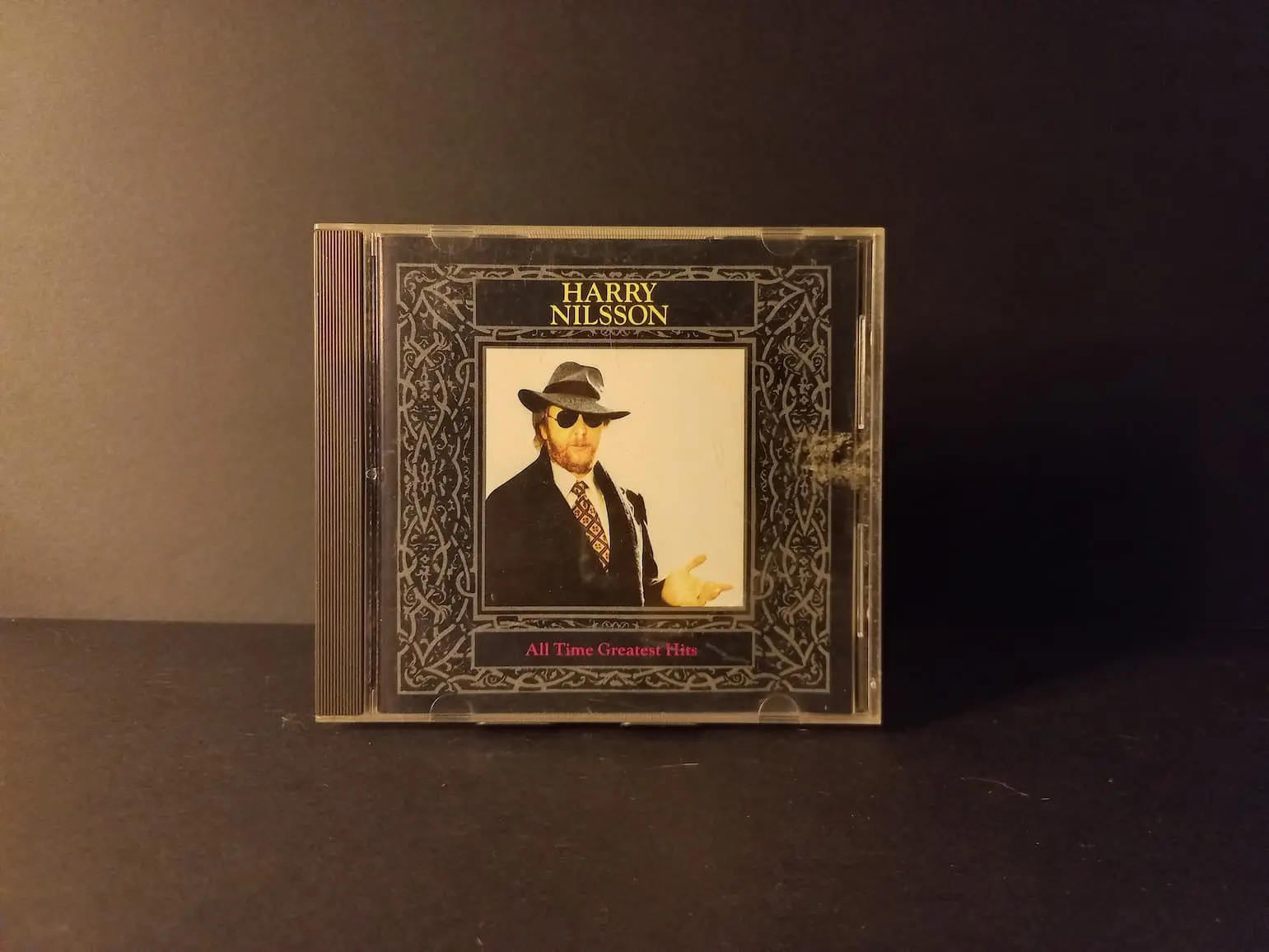
Through these records, I’m tracing the soundtrack of a life spent in motion, and in a way, trying to explain how music, memory, and geography blur together when “home” is always somewhere else. Harry Nilsson | All Time Greatest Hits is one of the few records that survived thousands of miles and countless reinventions.
I bought Harry Nilsson’s All Time Greatest Hits (1989) during the same CD-buying binge in San Francisco that’s responsible for Discovery of the Week: The Beta Band | The Three EPs. Somehow, All Time Greatest Hits wound up in Taipei, and now, Metro Manila. I’m not surprised it’s here; but I don’t have an interesting reason. It kept getting tossed into the box as I moved from one place to the next.

Nilsson’s All Time Greatest Hits Track Listing
| Song | Original Album | Year |
| Everybody’s Talkin’ | Aerial Ballet | 1968 |
| Sleep Late, My Lady Friend | Pandemonium Shadow Show | 1967 |
| Good Old Desk | Aerial Ballet | 1968 |
| Don’t Leave Me | Aerial Ballet | 1968 |
| 1941 | Pandemonium Shadow Show | 1967 |
| Cowboy | Nilsson Sings Newman | 1970 |
| One | Aerial Ballet | 1968 |
| Coconut | Nilsson Schmilsson | 1971 |
| Daybreak | Son of Schmilsson | 1972 |
| Without You | Nilsson Schmilsson | 1971 |
| I Guess the Lord Must Be in New York City | Harry | 1969 |
| Caroline | Nilsson Sings Newman | 1970 |
| Daddy’s Song | Aerial Ballet | 1968 |
| Jump Into the Fire | Nilsson Schmilsson | 1971 |
| Without Her | Pandemonium Shadow Show | 1967 |
| Me and My Arrow | The Point! | 1970 |
| Nobody Cares About the Railroad Anymore | Harry | 1969 |
| Spaceman | Son of Schmilsson | 1972 |
| As Time Goes By | A Little Touch of Schmilsson in the Night | 1973 |
| Remember (Christmas) | Son of Schmilsson | 1972 |
Nilsson & Me
Most of the songs on All Time Greatest Hits are part of my life like sidewalks and fire hydrants. I’ve been listening to Nilsson since the early 1970s when the theme song from The Courtship of Eddie’s Father (“Best Friend”) was my favorite part of Saturday mornings.
All Time Greatest Hits isn’t “the best” single-disc Nilsson compilation. For that, you should get Nilsson: Greatest Hits (1980) on RCA Records or fuck it, the double-disc Personal Best: The Harry Nilsson Anthology (1995). As with any Nilsson record, the whole is greater than the sum of its parts. Likewise, All Time Greatest Hits has a wonderful playlist that covers albums from Aerial Ballet (1967) to A Little Touch of Schmilsson in the Night (1973), arguably the peak era of his career.

Heard But Rarely Seen
Harry Nilsson was and remains one of the under-appreciated miracles in pop and rock music. He wrote chart-topping hits, won Grammy Awards, and released must-hear albums. With no formal training, Nilsson had a crystal-clear choir boy tenor and an impressive vocal range, generally cited as three to three-and-a-half octaves, extended from low bass notes (around C2) to high soprano notes (approaching C6). By comparison, Freddie Mercury’s vocal range spanned about three octaves (F#2 to G5).
Despite so many high-profile achievements in pop music, Nilsson was an artist who was often heard but rarely seen. Largely forgotten by the late 1970s, Nilsson recorded and performed sporadically throughout the 1980s and early 1990s. A resurgence of interest followed his death in 1994, cresting with the 2006 documentary Who Is Harry Nilsson (And Why Is Everybody Talkin’ About Him)?
In the meantime, Sony Music released various archive and compilation albums to exercise their legacy publishing rights. Otherwise, nobody is talkin’ about Harry.
So, what happened? Why isn’t everybody talkin’ about him?
The Nilsson Paradox
The Nilsson paradox was rooted in self-destruction, but the tree has many branches. Nilsson had a compulsive need to turn left when everybody wanted him to turn right. Championed by the Beatles, name-checked by Lennon and McCartney as their favorite American songwriter and vocalist1, Nilsson was stubbornly allergic to the machinery of fame. He refused to tour and sabotaged his own momentum by avoiding live television performances. His rejection of music industry pigeonholing compelled him to explore an eccentric range of material from standards (“As Time Goes By”) to psychedelic rock (“Jump Into the Fire”), infuriating the record label mooks who see talent in consistency.
An artist of contradictions, Nilsson’s songs can be acerbic, tender, funny, wistful, and occasionally brutal, splitting the difference between Brill Building toe-tappers and late-night confessionals. He could write a novelty hit like “Coconut” and a devastating ballad like “One”. Some of his greatest hits were performed by other artists, a sign of validation, or consolation.
Before he wrecked his voice, Harry’s three-octave range could pivot from a delicate, glassy croon to a high-pitched whine and growl without warning. His 1970 collaboration with songwriter Randy Newman, Nilsson Sings Newman, is probably the single greatest demonstration of vocal prowess by a male pop and rock singer—and I’m a huge Art Garfunkel fan.
The Cosmic Joke of Stardom
Harry had the voice of an angel, but like many high-octane artists, he had a hard-partying dark side. For every moment of brilliance in Nilsson’s music, there was a corresponding act of career-defying self-sabotage.

For example, at the peak of his powers as a songwriter and a commercial product, he followed the quirky baroque pop of Nilsson Schmilsson (1971) with the rude, schizophrenic pop rock of Son of Schmillson (1972). Music historians point to “You’re Breaking My Heart” as the first explicit, clearly enunciated “fuck you” heard on a widely released pop/rock record. The crude and blunt material alienated his fan base. And that was the point. Nilsson treated pop stardom like a prank, not an achievement.
Son of Schmillson went gold in the U.S. and “Spaceman” was a top 20 hit, so…no problem, right? For his next album, Nilsson ignored all advice and recorded, A Little Touch of Schmilsson in the Night (1973), consisting of 20th century standards like “As Time Goes By” and “It Had to Be You”. He considered it one of his finest moments, but producer Richard Perry and (the record label) RCA Victor called it “career suicide.”
However, Nilsson had an ulterior motive. His voice was trashed by drugs and alcohol. Touch was a last-minute dash to capture the essence of the voice that made him famous. As Nilsson acknowledged in 1988, “…the choir-boy thing is gone. I knew it then. I told both [producer Derek Taylor and arranger Gordon Jenkins], ‘This is the last of it.’ That incredible, flexible, rubber-band-like voice. I just barely snuck [Touch] in under the gun.”

The Lost Weekend Era and Beyond
And then, Nilsson went completely off the rails while recording Pussy Cats (1974) during the infamous “Lost Weekend” era with John Lennon. Stories about the pair became stuff of tabloid legend. Amid the coke and booze-fueled chaos, Harry ruptured a vocal cord during the sessions in Los Angeles but didn’t tell Lennon. Instead, he continued to strain his voice, doing irreparable damage.
Despite an impressive cast of guest appearances by Ringo Starr, Keith Moon, and Jim Keltner, Pussy Cats is an ambivalent and/or difficult listen. You can really hear the cocaine sometimes. But it also contains one of Harry’s most beautiful moments, “Don’t Forget Me”, a song that brings tears to my eyes every time.
Here’s where it gets sticky and I don’t want to say too much, but Nilsson’s recorded output from 1975’s Duit on Mon Dei and forward is very hit-or-miss. His final album for RCA Records, Knnillssonn (1977) was supposed to be a comeback album. People were saying that his voice had recovered from Pussy Cats, but I dunno about that, man. It didn’t matter anyway because shortly after the release of Knnillssonn, Elvis Presley died. RCA Records dropped everything to meet the demand for Elvis’ material, and Nilsson’s comeback never happened. And it didn’t help that he wouldn’t tour.
Denial or Acceptance
I can barely stand to hear Nilsson’s post-Pussy Cats work like …That’s the Way It Is (1976). The angelic tenor reduced to a husky baritone reminds me of my personal decline and failings in life. I’m older than Harry when he died at 52. Whether it’s denial or an alternate form of acceptance, I’m happier listening to “Without You” than this heartbreaking version of “Sail Away”. Hardly sounds like the same voice.
Footnotes
- The endorsement that effectively launched Harry Nilsson’s career occurred in May 1968 during a press conference at the St. Regis Hotel in New York City. John Lennon and Paul McCartney were in town to announce the launch of their new company, Apple Corps.
When a reporter asked the duo who their favorite American artist was, the exchange went as follows:
Reporter: “Who is your favorite American group?”
John Lennon: “Nilsson.”
Reporter: “Who is your favorite American singer?”
Paul McCartney: “Nilsson.”
This interaction is documented in several reputable rock histories, including Alyn Shipton’s Nilsson: The Life of a Singer-Songwriter and the documentary Who is Harry Nilsson (And Why Is Everybody Talkin’ About Him?). ↩︎
We welcome your comments!